ΤΟ ΒΗΜΑ στην Ιστορία
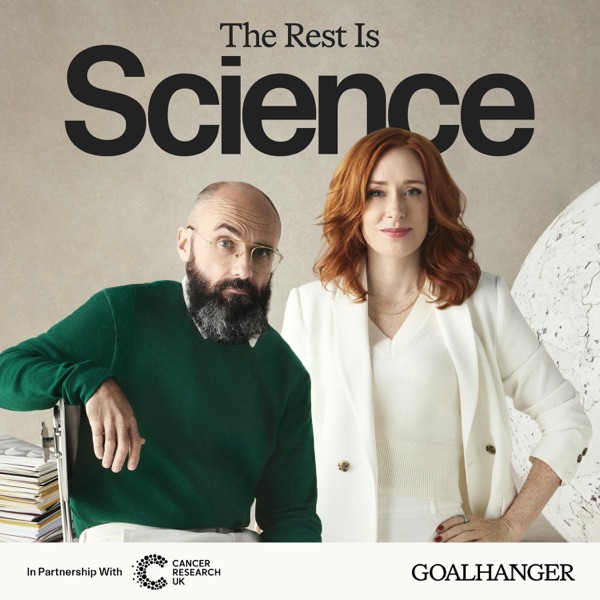
Is it better to own something amazing, or to actually experience it? Michael has built a collected a whole shelf of things he refuses to look at, smell or open, and he's about to defend every one of them. Professor Hannah Fry and Michael Stevens (Vsauce) are back with Field Notes, a show-and-tell where the star attractions stay firmly sealed. Is a puzzle still a puzzle if the answer is staring you in the face? What does the tail of a comet smell like, and why will Michael never find out? And what is hiding inside a mystery can that's been sitting on his shelf for years? Then it's over to your questions. Can you wake up from surgery knowing something you never learned? What is the oldest everyday object we still use, and where does Lizzo come into it? ------------------ For more information about Cancer Research UK, their research, breakthroughs and how you can support them, visit https://cancerresearchuk.org/restisscience Cancer Research UK is a registered charity in England and Wales (1089464), Scotland…
Is it better to own something amazing, or to actually experience it? Michael has built a collected a whole shelf of things he refuses to look at, smell or open, and he's about to defend every one of them. Professor Hannah Fry and Michael Stevens (Vsauce) are back with Field Notes, a show-and-tell where the star attractions stay firmly sealed. Is a puzzle still a puzzle if the answer is staring you in the face? What does the tail of a comet smell like, and why will Michael never find out? And what is hiding inside a mystery can that's been sitting on his shelf for years? Then it's over to your questions. Can you wake up from surgery knowing something you never learned? What is the oldest everyday object we still use, and where does Lizzo come into it? ------------------ For more information about Cancer Research UK, their research, breakthroughs and how you can support them, visit https://cancerresearchuk.org/restisscience Cancer Research UK is a registered charity in England and Wales (1089464), Scotland…
Is it better to own something amazing, or to actually experience it? Michael has built a collected a whole shelf of things he refuses to look at, smell or open, and he's about to defend every one of them. Professor Hannah Fry and Michael Stevens (Vsauce) are back with Field Notes, a show-and-tell where the star attractions stay firmly sealed. Is a puzzle still a puzzle if the answer is staring you in the face? What does the tail of a comet smell like, and why will Michael never find out? And what is hiding inside a mystery can that's been sitting on his shelf for years? Then it's over to your questions. Can you wake up from surgery knowing something you never learned? What is the oldest everyday object we still use, and where does Lizzo come into it? ------------------ For more information about Cancer Research UK, their research, breakthroughs and how you can support them, visit https://cancerresearchuk.org/restisscience Cancer Research UK is a registered charity in England and Wales (1089464), Scotland…
What if your thoughts, fears and desires weren't entirely your own? What if something living inside your body could change your behaviour, without you ever knowing? Professor Hannah Fry and Michael Stevens (Vsauce) enter the disturbing world of parasites. From worms that grow inside crickets to viruses that alter animal behaviour, they explore the extraordinary lengths parasites will go to in order to survive and reproduce. But how does one organism evolve the ability to manipulate another? How do parasites overcome the body's defences? Along the way, Hannah and Michael investigate 500 million year old fossils, parasites that hitchhike on mosquitoes, the strange science of rabies and the unsettling relationship between cats, rats and a parasite that may even influence our own behaviour. ------------------- For more information about Cancer Research UK, their research, breakthroughs and how you can support them, visit https://cancerresearchuk.org/restisscience Cancer Research UK is a registered charity in…
Michael Stevens and Hannah Fry explore the physical reality of deep-sea internet cables, examining their small diameter, their role as global data arteries, and the vulnerabilities they face from marine life and human activity. The discussion extends into the engineering of fiber optics, detailing how these cables can detect seismic activity and facilitate high-frequency trading through light speed advantages. The episode further delves into the intersection of perception, language, and mathematics, discussing how human sensory experience is limited compared to the vastness of reality. The hosts also explore the etymology of planetary names, the practical applications of knot theory in DNA, and the psychological benefits of rituals and 'manifesting' as tools for priming the mind.
In this 100th episode of The Rest is Science, Michael and Hannah debate whether the number 100 or 101 is superior. They explore various mathematical and historical perspectives, including the etymology of 'hundred', the benefits of base 12, the primality of 101, and the psychological impact of numerical thresholds in human behavior. The conversation further explores the arbitrary nature of the Kármán line at 100 kilometers and the origin of '101' as an introductory course designation. The hosts also discuss scientific phenomena involving element 100 (Fermium) and conclude with a mathematical exploration of Roman numerals being alphabetized.
The hosts explore historical audio recordings, ranging from the earliest known recording of a human voice in 1860 to large-scale crowd recordings from 1888. They discuss the technology behind phonautographs and wax cylinders, as well as the scientific possibility of capturing sound in physical objects like clay pots. The episode also covers the scientific discovery of the BRCA2 gene and investigates mysterious underwater sounds recorded by hydrophones. The discussion details how researchers used modern technology to identify the origins of sounds like the 'Biotwang' and the 'Bloop'.